Restoring function and alignment for young patients — with surgical and non-surgical techniques built around growing bones and the needs of children.
Children's bones are fundamentally different from adult bones — they contain active growth plates and heal faster, but they are also more vulnerable to injury-related deformity if treatment is delayed or misdirected.
Pediatric trauma includes fractures, growth plate injuries, and dislocations sustained through falls, sports, or accidents. Deformity correction addresses conditions like bow legs, knock knees, club foot sequelae, and post-fracture angular malalignment that affect how a child walks, runs, and grows. At Sevya, every child's case is assessed with the understanding that growing bone responds uniquely — and that the right intervention at the right time can prevent a minor issue from becoming a lasting problem.
A range of trauma and alignment problems in growing patients, from simple fractures to complex deformities.
Breaks involving the physis (growth plate) require careful management to prevent long-term growth disturbance.
Bow legs (genu varum) or knock knees (genu valgum) that persist beyond the expected developmental window may need guided correction.
Fractures that heal in a poor position can cause limb length discrepancy or abnormal gait, requiring corrective intervention.
Among the most common paediatric fractures — managed with precise reduction and, where needed, internal fixation designed for growing bone.
Elbow fractures in children are urgent — early treatment prevents neurovascular complications and long-term cubitus varus deformity.
Note: A thorough clinical examination and X-ray are always needed before deciding on the right treatment — book a consultation for a personalised assessment.
A methodical plan that accounts for age, growth potential, and the child's long-term function.
On-site digital X-ray combined with careful clinical assessment — identifying growth plate involvement and alignment angles precisely.
From casting and guided traction to minimally invasive fixation — the method is chosen to minimise disruption to growth while achieving reliable stability.
Regular reviews track alignment, limb length, and bone healing as the child grows — catching any late deformity early when it is easiest to correct.
They can be, if not treated correctly. Growth plate fractures that are not properly reduced and stabilised can disrupt normal bone growth, leading to deformity or limb length discrepancy. Prompt and accurate management is essential.
Most paediatric fractures are managed with casting alone. Surgery is recommended when the fracture is unstable, involves the growth plate significantly, or cannot be held in good position with a cast — this is assessed case by case.
Not always. Mild bow legs are normal in toddlers and usually self-correct by age 3–4. Knock knees peak around age 4–5 and typically resolve by age 7. Significant or progressive deformity beyond these ages warrants evaluation.
Children's bones heal faster than adults. A simple forearm fracture may heal in 4–6 weeks; more complex injuries take longer. Your surgeon will give a timeline based on the specific fracture, location and age of the child.
Cutting-Edge Care for Exceptional Outcomes
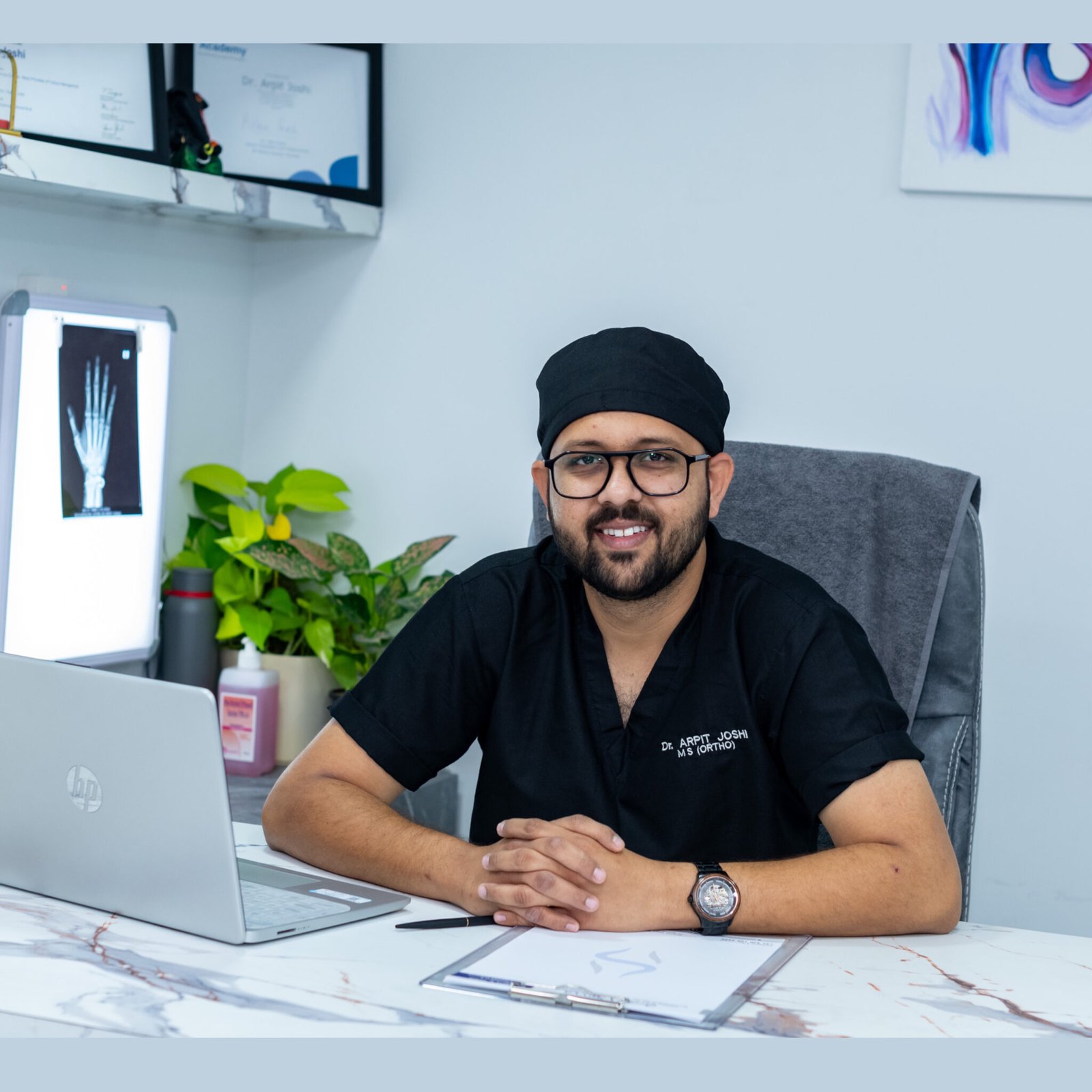
As a leading orthopaedic specialist in Ahmedabad, Dr. Arpit Joshi delivers evidence-based, transparent care for complex fractures, sports injuries, and debilitating joint pain. Merging advanced surgical precision with a strictly ethical, patient-first philosophy, he focuses on restoring true mobility and enduring bone strength without unnecessary procedures.
Have a question about your child's fracture or deformity, or want to schedule a visit? Send us a message and our team will get back to you.